Top Legal BriefElection law
The Mail-In Voting Order Reaches the Court on the Worst Possible Clock
With the midterms months away, the Justices are being asked to decide an election-administration question under emergency-docket conditions. The doctrine that decides it may be Purcell, not the Elections Clause.

Co-Founder & Chief Intelligence Officer · · 7 min read
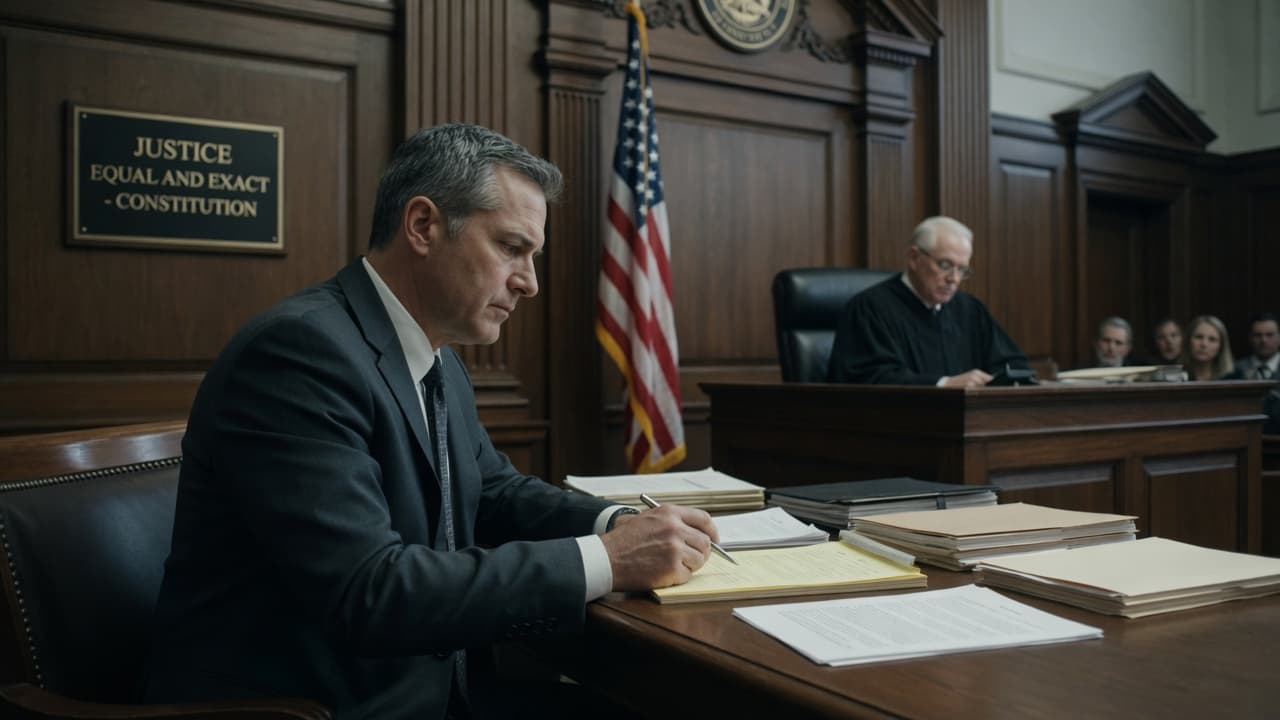
An engraved inscription on a courthouse facade reading Equal and Exact Justice
The brief in 60 seconds
- A federal district court allowed a challenge to the executive order restricting mail-in voting to proceed as to the 2026 midterms; the administration and several states have asked the Supreme Court to permit full implementation.
- The merits question — how far federal executive authority reaches into the mechanics of federal elections — is genuinely hard and unresolved.
- The likelier disposition is procedural. The Purcell principle counsels against changing election rules close to an election, and it cuts against whichever side is seeking the change.
- Election administrators, not litigants, bear the cost of a late ruling. Counsel advising state and county officials should be building for both outcomes now.
The posture
A federal district court has permitted a challenge to the executive order restricting mail-in voting to go forward with respect to the midterm elections, and the administration — joined by a group of states — has asked the Supreme Court to clear the way for the order's full implementation. The application sits on the emergency docket, which means the Justices will decide it on compressed briefing, without argument, and with reasons that may run to a paragraph.
That is an unsatisfying way to resolve a question this consequential, and it is worth naming the reason it happens: election-law disputes are filed late because the rules themselves are set late. The remedy is legislative, not judicial, and Congress has shown no interest in supplying it.
The merits question is real
The Elections Clause assigns the "Times, Places and Manner" of congressional elections to state legislatures, subject to alteration by Congress. It does not, on its face, assign anything to the President. Defenders of the order therefore lean on statutory authority and on the executive's role in administering federal law rather than on any freestanding Article II power over elections.
That is the argument's weakest joint and its most interesting one. If the order rests on a statute, then the question is ordinary statutory interpretation, and the major-questions reasoning the Court has applied to agency action over the last four terms points toward requiring a clear congressional statement. Election administration is precisely the kind of vast, politically contested domain in which the Court has demanded that Congress speak plainly.
There is an irony here that both sides should sit with. The doctrinal tools conservatives built to restrain the administrative state do not switch off when a Republican administration invokes them. A clear-statement rule that applies to the EPA applies to an election order too. That consistency is the point of a rule.
Purcell is the likelier answer
The Purcell principle — that federal courts should ordinarily not alter state election rules on the eve of an election — has become the Court's preferred off-ramp in cases like this one. Its appeal is obvious: it disposes of the application without resolving anything, and it protects administrators from having to reprogram systems mid-cycle.
Its weakness is equally obvious. Purcell has no fixed clock. "Close to an election" has been applied to periods ranging from weeks to the better part of a year, and the principle has an uncomfortable tendency to favor whichever party benefits from the status quo. Applied here, it would likely leave the district court's order undisturbed and postpone the constitutional question past November.
For anyone who cares about election integrity as a substantive matter rather than a slogan, that is a poor outcome. Rules that are litigated but never resolved are the worst of both worlds: contested enough to erode confidence, unsettled enough to be relitigated every two years.
What officials should do now
Counsel advising secretaries of state and county boards should assume neither outcome. Build the ballot-processing workflow so that the verification requirements in the order can be switched on or off without a rewrite, document the chain of custody at every step, and get the voter-communication materials drafted for both regimes in advance.
The operational risk is not the ruling. It is the gap between the ruling and the first day ballots go out. A decision in mid-September leaves weeks; a decision in October leaves days.
Bennet's election-administration desk is tracking the docket and the state-level implementation guidance in parallel. Clients who need the current posture jurisdiction by jurisdiction can request the running matrix.
What the desk read
The Top Legal Brief is editorial analysis produced by the Bennet Intelligence Desk. Bennet Legal Research Group is a research and intelligence firm, not a law firm; nothing here is legal advice or a substitute for counsel. Views expressed are the author's own.
Need this level of analysis on your matter?
The desk that writes this brief every morning runs the same research discipline on client engagements.
Request Intelligence